
Farewell to a Friend: A Chance Encounter and a Lifetime of Memories
The Experimental Aircraft Association’s annual convention – AirVenture – in Oshkosh, Wisconsin, is far more than an airshow. This fact is so often lost to the casual observer, but for those who have attended for many years, the show becomes a family reunion, a look back, and a look forward. Long-time attendees are filled with stories of random encounters and chance meetings with friends, new and old. Friends in the aviation community come in two forms: the flesh and blood of humanity, and the seemingly inanimate conglomerations of aluminum, fabric, rivets and engines that lift us above the earth. Yes, these, too, can become friends.
Let me tell you about one.

N4550J departing Oshkosh, Wisconsin, on July 21, 2015. Here she wears full ALSIB 2015 titles.
It started as a random glance at FlightAware, the popular flight-tracking website. I was strolling the grounds at this year’s show in Oshkosh, and happened to look at the list of inbound aircraft. A tail number caught my eye. N4550J. N4550J. I know you. You see, this airplane was one of those old friends. In an odd way, I grew up with it. Years ago, in the late 1990’s and early 2000’s, the plane – 50J for short – was based at my home airport, Moore-Murrell Field in Morristown, Tennessee. It was a tired old freight dog by then, used mostly to carry auto parts between southern suppliers and northern factories. It was also the first “big” airplane I ever saw, and to a four-year-old, craning his neck upward, a Douglas DC-3 really is a big airplane. Just seeing the number brought back fond memories: standing underneath the airplane, only a toddler, with my dad, fascinated by the enormous engines above my head. I recalled the oil buckets placed carefully beneath each engine: one should only worry, it was once said, if radial engines don’t leak oil. I still vividly remember getting my very own tour of the airplane: the steep walk up through the inclined passenger compartment; the look inside the narrow cockpit door; the old-fashioned dials, gauges, and levers; the windscreen with a view only of blue skies above. These were the airliners of old, they said. Early on, I learned to love this machine. I’d always want to go look at it. The indescribable appeal of old airplanes caught me in its grip early on, and never let go.
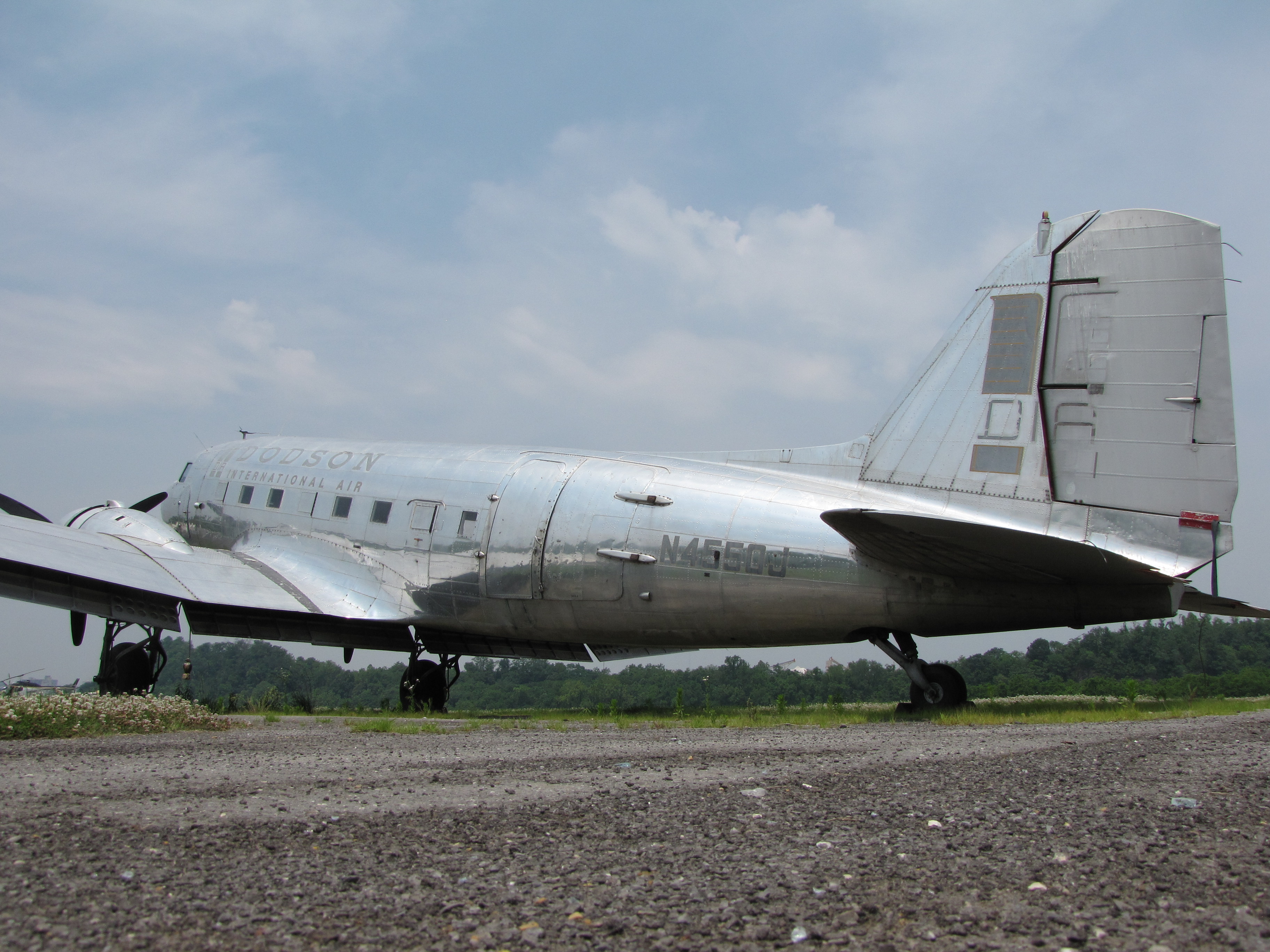
Here is 50J during her period of storage at Downtown Island Airport in Knoxville, Tennessee in 2010. This perspective was an attempt to illustrate how large the aircraft once appeared to me, at a young age. Here she wears the prior scheme, in the colors of former operator Dodson International Air.
And, yet, the wings of progress and the fires of economic calamity would spell the end. Detroit and its winged suppliers failed to escape the recession. Mother Nature spurred a brief flurry of activity: 50J was pressed into service after 2005’s Hurricane Katrina to fly rescued dogs from the Gulf Coast to new homes and shelters inland. Yet, even as those Louisiana floodwaters receded, the cargo business in Morristown dried up, slowly but surely. More and more, the airplane was parked on its lonely, deserted tarmac home. It passed the years out there, six decades removed from its genesis in a Long Beach factory in World War II’s darkest days.
Reprieve and salvation emerged in the format of a gleaming sister aircraft. N17334, that one was registered. Many know it as the Flagship Detroit, an immaculate DC-3 restoration completed by the employees of American Airlines to honor the company’s long heritage. The Morristown owners of 50J, being one of the few DC-3 maintenance providers to be found, were eventually retained to complete maintenance on the Flagship. One day – around 2007 – both airplanes were parked at Moore-Murrell, side by side. The contrast was remarkable; on one side, the mirror-finished, blindingly-reflective, orange-striped DC-3 with freshly painted American Airlines titles; on the other, 50J, in the same dull metallic glory I had always known. Beauty isn’t only skin deep when it comes to airplanes. Their beauty lies within. 50J won the beauty contest that day, in my eyes.
Needless to say, DC-3 pilots are difficult to come by, and the Flagship was far too valuable to be used for training circuits. So 50J found a new purpose in life. She was flown to Shelbyville, Tennessee, and there became the official training aircraft of the Flagship Detroit Foundation. It was a fitting mission, in a way. She wasn’t beautiful in the cosmetic sense of the Flagship, but she was experienced, and wise, and became a training tool for pilots whose grandparents grew up flying aboard her. The days of passenger service had passed by. Domestic auto manufacturing was collapsing, carrying 50J’s freight contracts into the abyss with it. But here was a new goal, a new mission, a new purpose. This plane that had seen so much, that had traveled the world since the days of Franklin Roosevelt, still had lessons to teach for those who cared to learn.
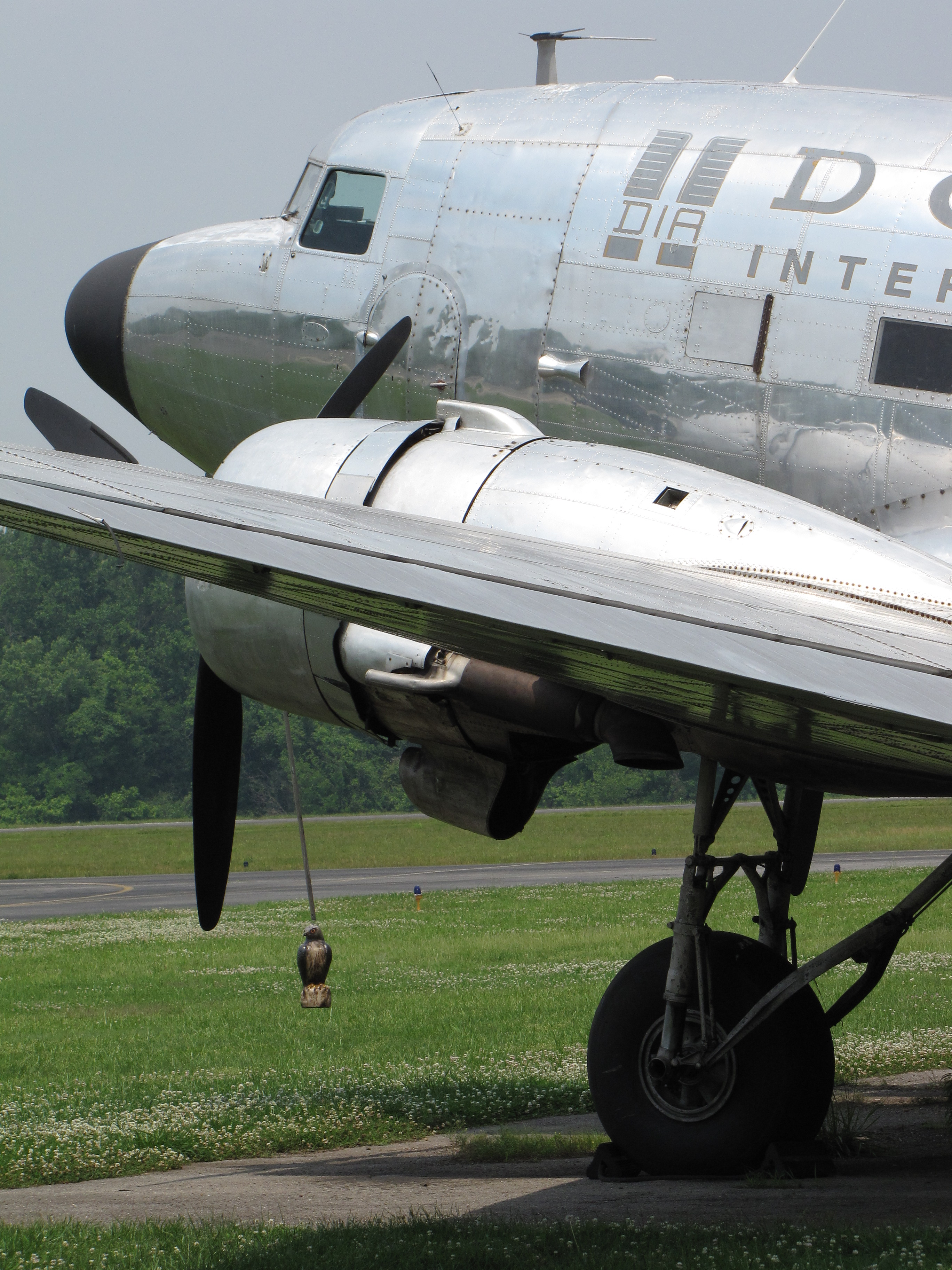
N4550J at Knoxville, 2010. Note the suspended hawk figurine, intended to keep birds away from the engines.
Nothing, sadly, is forever, and I met the airplane again in 2010. I was at Knoxville’s small Downtown Island Airport when a big silver airplane parked in a remote corner of the field caught my eye. I knew that dull glint anywhere. It was 50J, back in East Tennessee. I walked over, camera in hand. She looked the same as ever. The old Dodson International titles were perhaps a bit more faded than the last I’d seen them, but the worn livery still carried its comfortable familiarity. I walked all around, making photographs and reminiscing about the old days. The plane still looked big to a fifteen-year-old, but not in the striking way it had over a decade before.
She languished in Knoxville for some time. A destructive April 2011 hailstorm damaged her control surfaces, and repairs were slowly completed under the blazing summer sun. Her owners decided the end had come, and a sale was supposedly arranged, either to Puerto Rico or the Dominican Republic. This was not completed, and 50J found her way to Kentucky. For a brief time, her role as a freighter was reprised. There were a few more all-night runs, carrying who knows what for who knows who. 50J had been born on the right side of the Depression, emerging into the California light after economic calamity had been swept away by the crashing waves of war. This recession was not so survivable, and presently the airplane went up for sale.
For the intervening period, I lost track of 50J, unaware of her whereabouts. Indeed, until Oshkosh this year, I had not thought about the airplane in some time. And so it was that on a glowing Wisconsin summer evening, we had our reunion out in the grassy fields of Wittman Regional Airport.
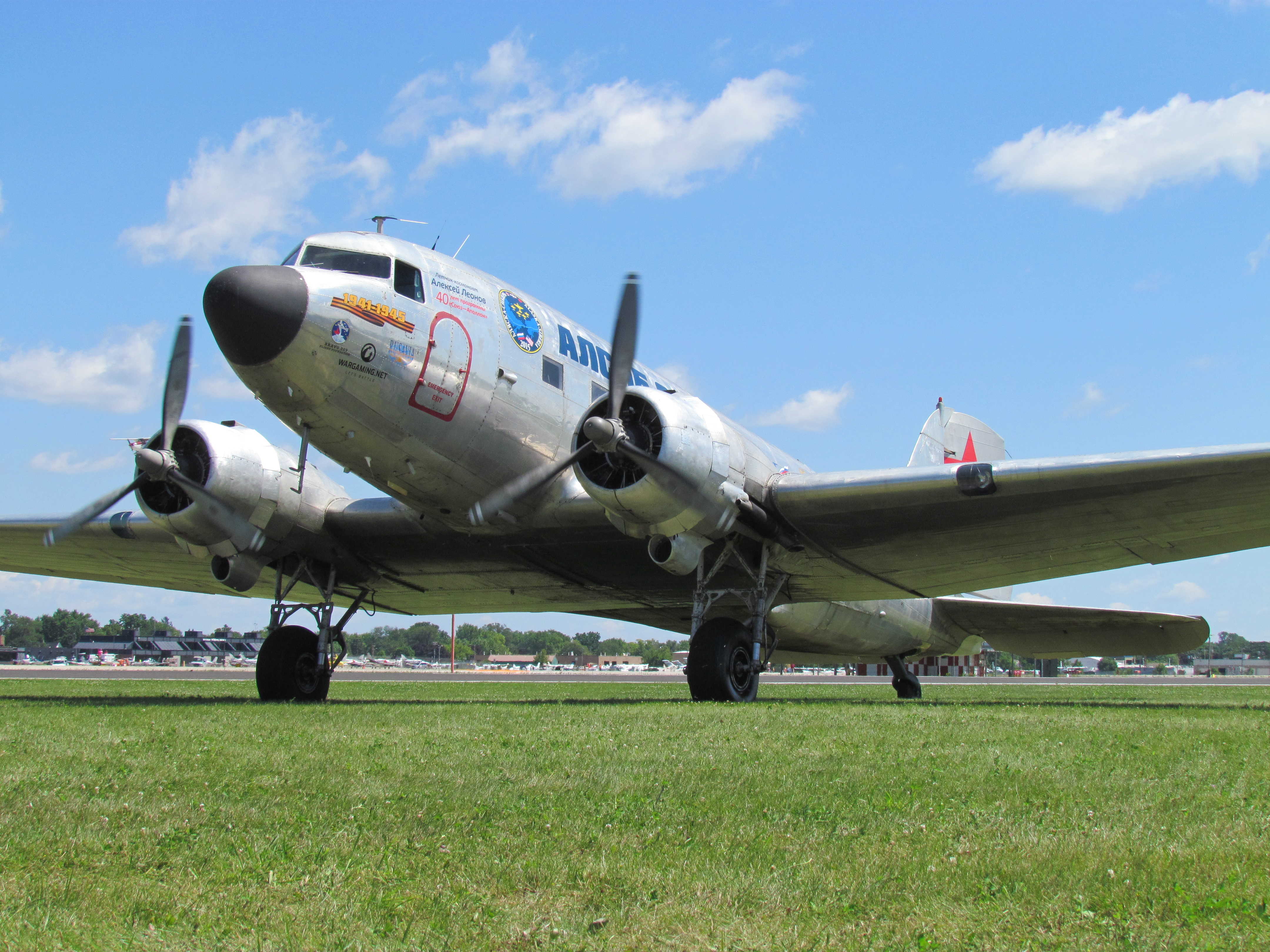
N4550J looms above my head one last time, preparing to depart Oshkosh for a new home in Russia.
Wow, it looked different. Gone were the old Dodson colors. As I stared south across the runway at my newly arrived old friend, I marveled at the change. She was emblazoned with all sorts of bright decals and insignia. My eyes quickly drifted to a large red star painted near the tail. How odd, I thought. What is this about? More Russian titles caught my eye. Where the Dodson titles had once been was now a Cyrillic Aeroflot decal and the words ALSIB 2015. I smiled a bit when I noticed the familiar old block letters beside the mammoth tail: N4550J. Try as they might, they still couldn’t get rid of that old familiar livery. Yes, indeed, here she was, basking in golden light on a beautiful July evening. Why, I wondered? What brought her here?
Google told me. I searched for ALSIB 2015, and quickly found results. It is an acronym for Alaska-Siberia 2015, and is a commemorative flight in honor of those who ferried aircraft over the frigid waters of the Northern Pacific during World War II. 50J, it turned out, had been acquired to participate in the flight, which was to begin at Great Falls, Montana, in two days. That’s great, I thought. Living history.
I read on.
“After the flight, the planes will be transferred to the Museum of the Armed Forces of Russia.”
Damn.
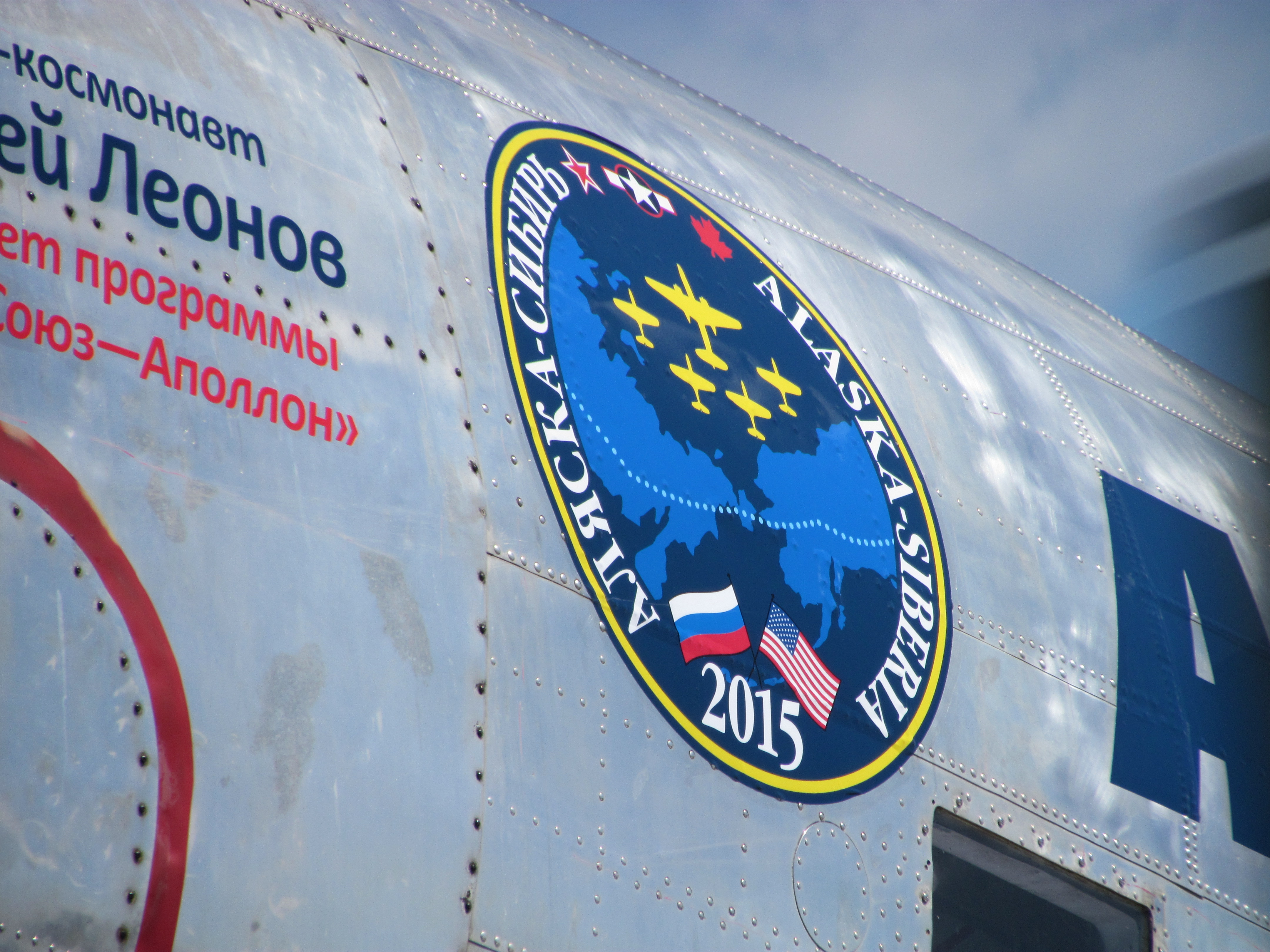
A close view of the ALSIB 2015 mission insignia, painted on the forward left fuselage. Note the lettering in both English and Russian.
That was my reaction. Selfish, of course. What better way for a faithful airplane to meet her end, on display in a museum someplace? I’ve seen too many just rot away, or be cannibalized for spare parts. Preservation in a museum is the rarest of retirement gifts bestowed upon our faithful winged friends. Even so, I couldn’t help the twinge of sadness that hit me as I read the words. Why couldn’t it be a museum here? Why there? Alas, the happy reunion had become a poignant goodbye. I looked across the field at her, resplendent in those new colors. I next looked at the sun sinking below the western horizon. Well, I thought. It’s rising in Russia. Off into the sunset, off at last into retirement.
Early next morning, I went to see her. My timing couldn’t have been better. The flight crew was boarding. It was a beautiful morning, as I stood once again beneath the giant fuselage, eyes wandering across familiar details. I thought about my four-year-old self, removed by six hundred miles and sixteen years. Maybe, just maybe, things weren’t so different after all. 50J still looked the same to me. Why, I wondered? Maybe because I’d learned to see beneath the paint, new or faded, beneath the dirt and dust and grime, into the throbbing radial heart inside. I owed this airplane something, I realized. Maybe that old freighter spurred the passion for aviation that I carry with me always. Maybe airplanes don’t have a personality in the human sense, but perhaps they can shape people. I know this one shaped me.
All too soon, the majestic radial engines came to life, throbbing, sputtering, producing great amounts of black smoke. An orange-vested flagman came forward, ready to direct the airplane off on her last journey. The throttles were advanced, and the big tires dug into the soft grass. 50J began to roll.
So this was goodbye.
I watched her taxi forward, then make the sharp right turn onto the active taxiway. A great cloud of smoke, dust, and dirt flew up. Something was in my eye, and I blinked it away.
Moments later, I heard the rumble from down the runway. N4550J was leaving. I turned to watch. All at once, she was airborne, right in front of me, banking sharply off to the right, into the mystic of an unknown future a world away.
Farewell, my old friend. Thanks for all the memories.
And maybe I’ll go to Russia someday.

Farewell and Godspeed, N4550J.
Lyrics from “Now Comes the Night” by Rob Thomas.
Author’s Note
The history of N4550J is fascinating to study in itself. Delivered in 1942, registered 41-38672, she first served with the United States Army Air Force, with units in North Africa and the Netherlands. She was transferred to the French civilian register as F-BEFF and saw service with a collection of French aviation companies, among them Aigle Azur, UAT, and Autrex (when she potentially flew in the former French Indochina). From there, F-BEFF entered service with the French Air Force, first with bureau number 38672 (derived from her former USAAF identity), and then a series of civilian registrations, ending her military service in 1973 at the age of thirty-one. From France it was off to warmer climes – the French West Indies – where she flew as F-OGFJ for Air Antilles, Air Martinique, and Air Guadeloupe. (Here she is seen in Air Antilles colors at Guadeloupe in 1976). She finished her career in the Caribbean with Air Guadeloupe (seen here in 1981) in 1983, when she was transferred to a new owner via Opa Locka, Florida, entering the U.S. register as N4550J. She wore the Air Guadeloupe colors – minus the titles – until at least 1992, eventually being painted in the Dodson International Air livery, which remained for the duration of her service life in some capacity.
Sources for the above include:
The Warbird Information Exchange
One can learn much about the ALSIB 2015 flight by visiting the website of the Bravo 369 Flight Foundation here: http://bravo369.net
Their mission was remarkable, and they deserve all credit for making it happen, and preserving these stunningly vital, yet often forgotten pieces of history.
And, finally, I have found photo confirmation of my beloved bird’s arrival in Russia. Here she is, with a sister ship, on display in Russia on August 7.
 Thoughts from Aloft
Thank you for a great rememberance of a great airplane. My first airplane job as a newly minted multi-engine pilot. The 800+hours I spent in her were filled with learning and amazement! Truly the most adventurous time of my life! I’m very thankful to have had the opportunity to be graced by time spent in her cockpit! Thank you again for sharing your thoughts on the most wonderful airplane I have flown!
Very well written Mathew!I too have many memories of 50j,Having spent almost 1000 hours on dark and stormy nights flying her here and there,you could usually predict where you were going to fly to each night by watching the weather,seems like if it was storming thats where we would end up!My proudest moment was when Ron let me fly as captain after getting my ATP and type rating in 50j.